ReadWith

Hi, Pascal here, the maker of ReadWith.

I’m happy to announce that ReadWith is now available for everyone.

ReadWith is for the person who keeps saying, “we should read this together.”

That might be a team lead, a coach, a teacher, a pastor, an author, a community organizer, a friend who gathers people, or someone who simply knows that a book can do more when it is read in good company.

See plans & pricing

Guests read free. Organizers can start with a 7-day trial. No credit card needed to start.

What ReadWith helps you do

ReadWith gives leaders a practical way to organize a small reading group:

  • Invite people around a book without needing a big program, curriculum, or community platform.
  • Set reading goals so the group has a rhythm and a shared sense of progress.
  • Share notes without spoilers by revealing the group’s notes only up to the point where each person has read and responded.
  • Give quieter readers a way in before the live discussion, so the group hears from more than the fastest talkers.
  • Keep the book at the center instead of scattering the conversation across chats, documents, and calendar invites.

Here’s how ReadWith looks:
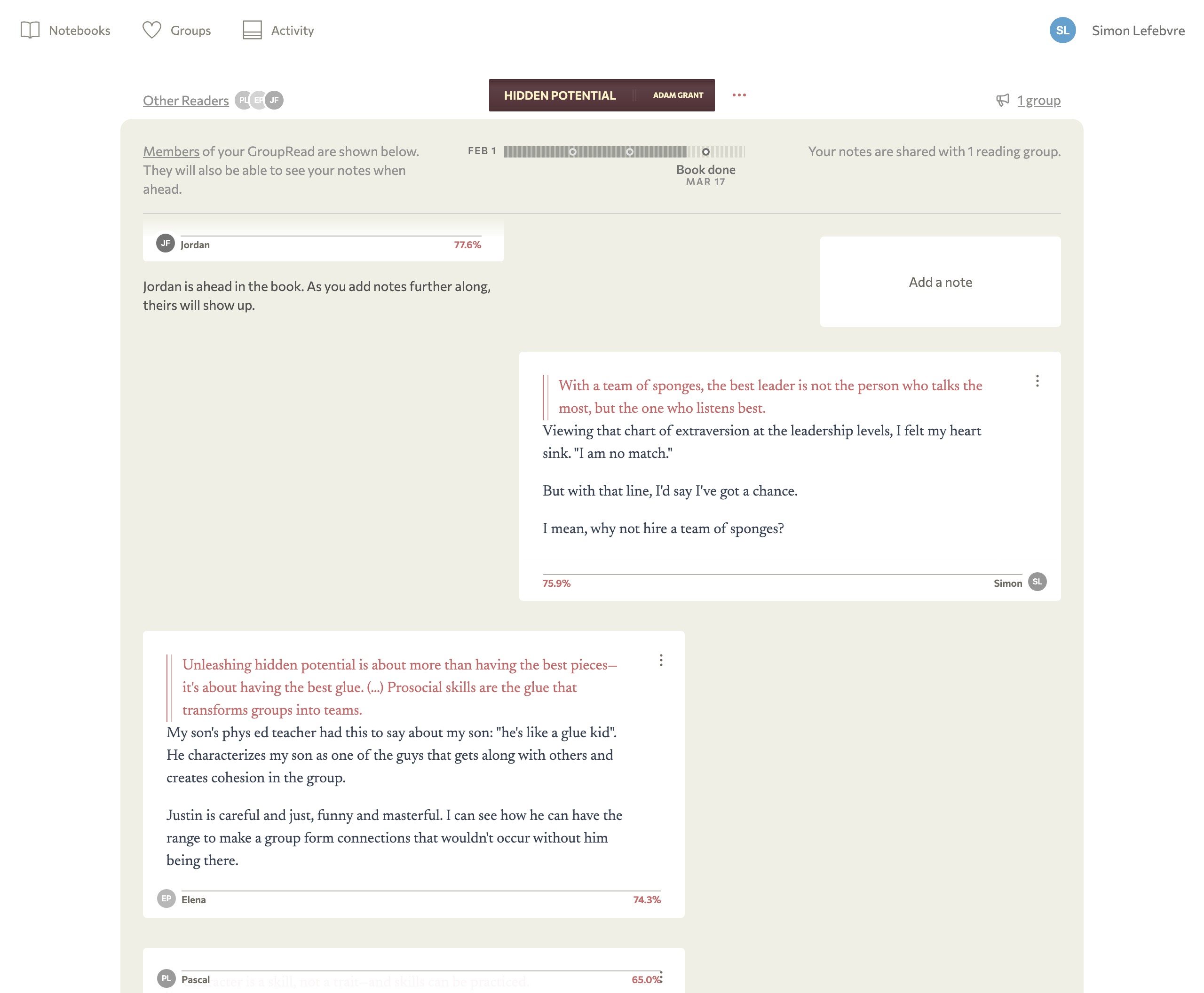
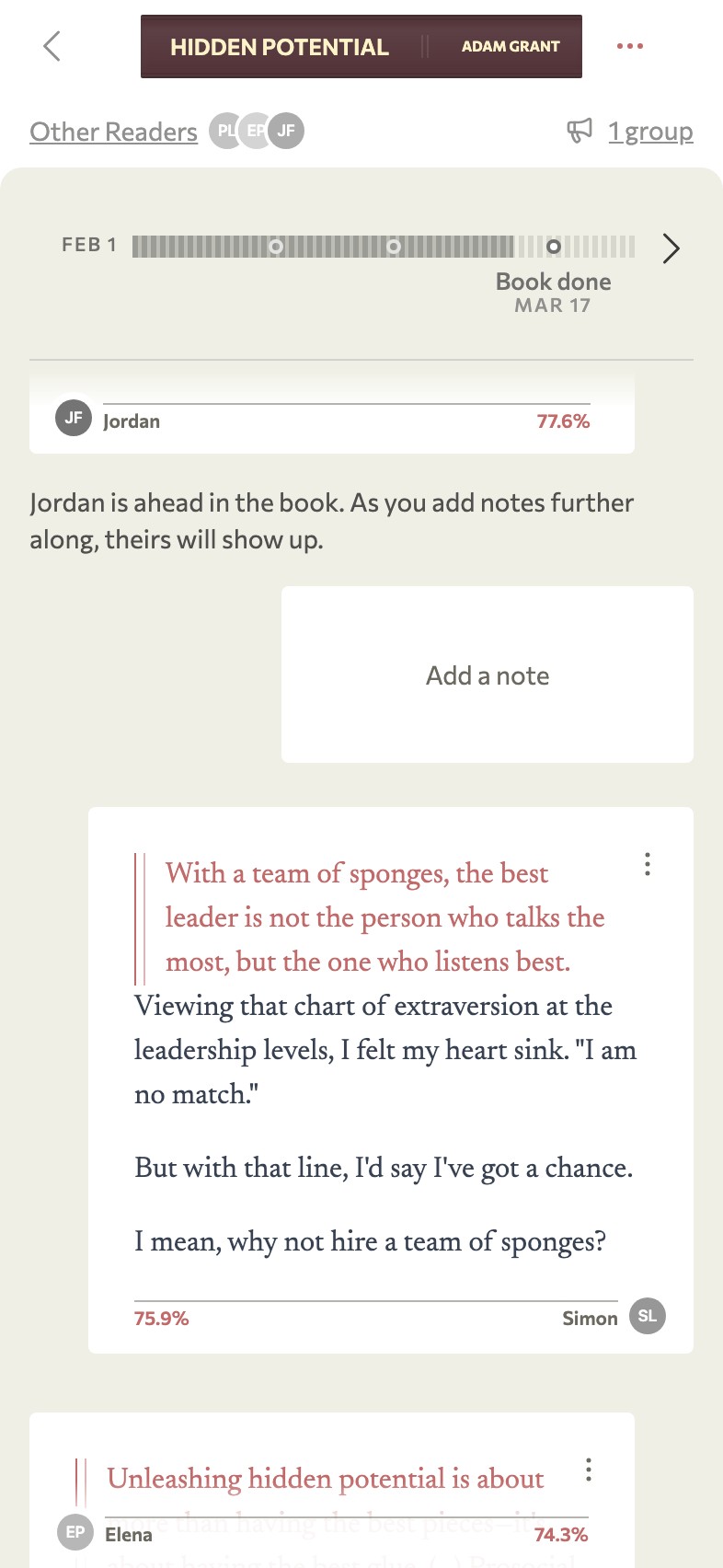
Screenshot of ReadWith's reading notes, with a note ahead from another reader
"Jordan has entered thoughts further along in the book". ReadWith only shows notes from other readers up to the point where you contributed your latest note.
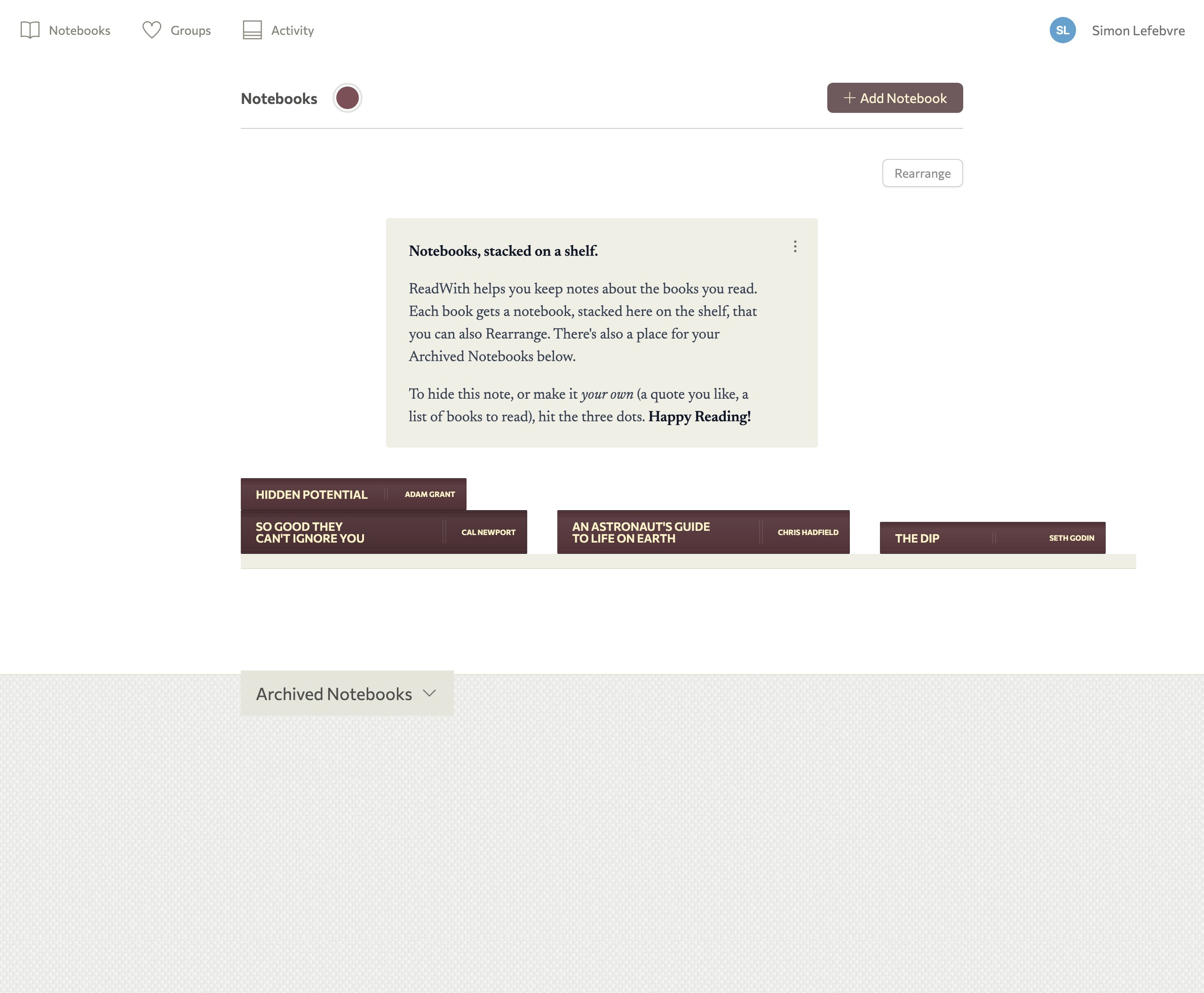
Screenshot of a list of notebooks stacked on a shelf in ReadWith
A list of notebooks stacked on a shelf, one for each book you read. Arrange your notebooks based on what you're reading, or rearrange to drag a notebook to the archives.

A different take: reading notes meant to be shared

Most reading tools are built for the individual: save highlights, collect notes, build a private archive.

Most group tools are built for conversation: chat, meetings, comments, threads.

ReadWith, on the other hand, is built for shared reading.

When someone reacts to a passage by sharing a note in ReadWith, they get rewarded by seeing what other readers in their group have said up to that same place in the book. That means the group can learn from each other without spoiling what comes later. You get the feel of a live reading group, where everyone shares (in awe) over a specific passage, but asynchronously.

For leaders, ReadWith helps in a few ways, because a reading group often fails for ordinary reasons. People fall behind. The strongest voices dominate. The group loses track of where everyone is. Good intentions turn into one more thing to manage.

ReadWith gives the leader enough structure to help the group keep going, while leaving the reading itself human, personal, and surprising.

Who should try it

If you lead people and there is a book you want to explore with them, ReadWith is for you.

It can start with two people. It can be a short book. It can be one chapter a week. It can be a group at work, a community group, a group of friends, or a set of readers gathered around an author.

You do not need to become a course creator. You do not need to run a full learning platform. You just need a book, a few people, and a reason to read it together.

It’s for those who feel the craving to take the lead.

A summary for media use

If you cover books, workplace learning, communities, creator tools, or the future of reading, the short version is this:

ReadWith is a small-group reading platform that helps leaders organize reading groups and lets members share notes without spoiling later parts of the book.

It is a product for a very old behavior: people changing together because they read together.

Start a group

ReadWith is open now.

If you are ready to organize a group, you can start here:

See plans & pricing

Guests read free. 7-day Organizer trial. No credit card to start. Already invited? Sign in.

I’ll keep sharing updates through ReadWith Bulletins as the product develops from here.

– Pascal

Hi, Pascal here, the maker of ReadWith.

UPDATE, June 16, 2026: ReadWith is now available for everyone. Read the launch announcement.

I’ve been working on ReadWith, a novel way to run reading groups. I’ll have a launch announcement soon, but in the meantime, I have a gift for those joining the waitlist. But before, a quick intro to ReadWith.

About ReadWith

ReadWith introduces a novel way to share notes with a reading group, and gives leaders of all kinds the tools to organize a reading group.

Here’s a preview of a thread of notes in ReadWith:

Screenshot of ReadWith's reading notes, with a note ahead from another reader
"Jordan has entered thoughts further along in the book". ReadWith only shows notes from other readers up to the point where you contributed your latest note.
Screenshot of a list of notebooks stacked on a shelf in ReadWith
A list of notebooks stacked on a shelf, one for each book you read. Arrange your notebooks based on what you're reading, or rearrange to drag a notebook to the archives.

There’s a way for you to try out this reading group experience, and so this is where the gift comes in.

A gift: Unread Bookshelf

I wrote a short book called Unread Bookshelf — On The Books We Meant to Read. About 20 pages, in PDF and EPUB. Fifteen essays on guilt, pleasure, Tsundoku, and getting back to the books you meant to read.

Join the ReadWith waitlist and your welcome email includes download links for the booklet. It’s free for the waitlist/newsletter subscribers.

As another bonus (also in the welcome email), along with the book there’s a special link to join a 1:1 reading group with me, the book’s author, with notes about the topics of the book from my perspective. The inside track on writing the book, essentially, and a way to get a sneak peak at how ReadWith works. I think you’ll like it.

More about the booklet

Join the waitlist

What you’re signing up for

  • Waitlist — updates as ReadWith gets closer to launch; early access when we open.
  • Bulletins — occasional notes from me with updates on ReadWith and related promotions.
  • Welcome email — PDF and EPUB for Unread Bookshelf right after you confirm.

– Pascal

This is a sample chapter from newly-launched book called Unread Bookshelf - On The Books We Meant To Read


The Japanese have a word:
Tsundoku.

It refers to the practice of owning books that are not meant to be read.

Books organized in a pile, so that you can be in the presence of books.

Books filling up a wall of shelves, to overwhelm. You won’t have the capacity to read them all, and that’s the point.

Something happens, visually, when there are too many details.

The Japanese have another word for that:
Shinrin-yoku.

It means “forest bathing”, a practice offering therapeutic relaxation by being subjected to the overwhelming visual details found in nature. In that setting, the mind relaxes.

A wall full of books might offer you a similar, relaxing feeling.

Whether for relaxation, or for the pleasure, or for creating humility (how will I ever read all these books?), maybe the antidote to an unread bookshelf is a bookshelf that you won’t ever intend to read.


More essays like this, for encouragement on resetting your relationship with all those unread books, consider buying Unread Bookshelf - On Those Books We Meant To Read.

Hi, Pascal here, the maker of ReadWith.

I’m getting ready to launch ReadWith to a wider audience soon. In the meantime, I’ve got a special pre-release offer.

Some of you are looking forward to the upcoming book Leading in Chaos by Nicholas Janni and Amy Elizabeth Fox, launching April 7, 2026.

Here’s the special offer:

Organize a reading group of up to 10 people for Leading in Chaos, for a one-time purchase of $20 USD. Only the organizer pays.

Learn About This Offer

About ReadWith

ReadWith gives you a way to share notes in a way that feels like a live reading group discussion. Everyone gets a chance to share their insight. Once you do, you get rewarded with other people’s notes up to that point in the book, where you shared your reaction to a passage.

Set some goals “Part 1 done by mid-May”, invite some people, organize calls. All from within ReadWith.

Screenshot of ReadWith's reading notes, with a note ahead from another reader
"Jordan has entered thoughts further along in the book". ReadWith only shows notes from other readers up to the point where you contributed your latest note.
Screenshot of a list of notebooks stacked on a shelf in ReadWith
A list of notebooks stacked on a shelf, one for each book you read. Arrange your notebooks based on what you're reading, or rearrange to drag a notebook to the archives.

About Leading in Chaos: A Clarion Call To A New Future

In this “grounding new book”, authors Nicholas Janni (Business Book of the Year winner for Leader as Healer) and Amy Elizabeth Fox (CEO of Mobius Executive Leadership) bring forth the premise: leading through chaos requires more than new skills. It requires inner transformation — developing presence, consciousness, and deep human connection. It requires refined relational skills and the capacity for adaptive change.

I hope ReadWith will allow you to study the book more deeply, with your peers, friends, and coworkers.

Continue to Special Offer

– Pascal

Try ReadWith

Unread Bookshelf book cover by Pascal Laliberté

Unread Bookshelf — free when you subscribe

On The Books We Meant to Read

Subscribe to ReadWith Bulletins for updates on ReadWith development and promotions. Your welcome email includes PDF and EPUB download links for this 20-page booklet, to help with the books on our shelves that we meant to read. Read it on your own, or alongside the author's notes in ReadWith (to give the app a try).

Free to join · No credit card · Bulletins · PDF & EPUB included